Back to all units

Grade 6 Science Vocabulary · Trimester 3, Unit 5

Motion

Describing motion by speed and direction, finding speed from distance and time, and reading position-time graphs to compare fast, slow, and stopped objects.

Ohio science standards in this unit

  • 6.PS.4 · Speed & motionAn object's motion can be described by its speed and the direction in which it is moving.

12 science words (Tier 3) and 6 academic words (Tier 2). Every word has a plain-language definition and an example sentence, written to support WIDA's Standard 4 (Science) English Language Development standard.

One word list, many ways to practice

These are the same 12 words, used in different tools. Students can start any of them right away. No student accounts or sign-in.

See the words in a picture

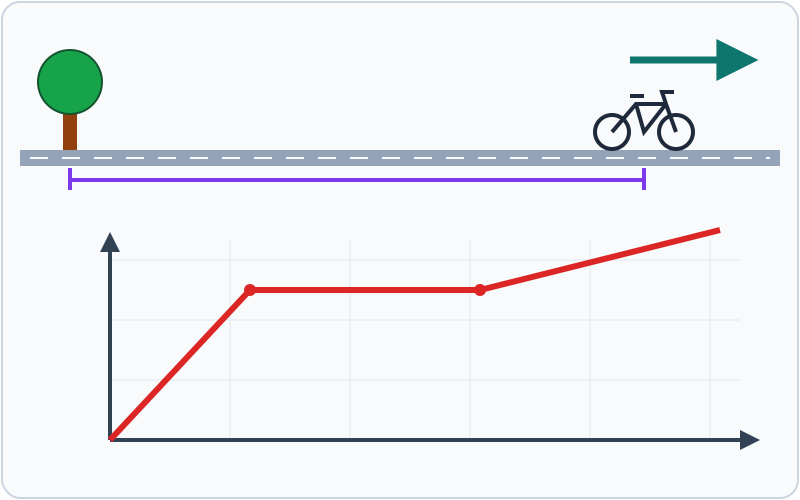
Label the Diagram: A bike ride and its position-time graph

A road with a tree at the left end and a bike at the right with an arrow in front of it and a bracket between them, above a graph with a line that rises steeply, stays flat, then rises slowly.

Students place 7 words on numbered spots: reference point, distance, direction, position, elapsed time, constant speed, stationary. They can turn on meanings and hear each word read aloud.

Teachers: open the same picture in ELLEvision to move labels, add words or audio, and publish your own version. ELLEvision needs a teacher sign-in.

Label the diagram

Break words into meaningful parts

Build It in ELLEments

Science words are often built from smaller parts. 4 words in this unit come with their parts ready, so students can hear each word, read it in a sentence, and build it from its pieces.

  • positionposition

    Mark the ball’s position every second.

  • constant speedconstantspeed

    The train moved at a constant speed across the flat land.

  • directiondirection

    The ball changed direction when it hit the wall.

  • stationarystationary

    The parked bus is stationary.

Tier 2 · Academic language

Words students need to talk and write about this unit

These are not science words, but students meet them in every task and question. Pre-teach them alongside the science words.

describe
To tell what something is like.
“Describe the motion of the cart using speed and direction.”
calculate
To find an answer using math.
“Calculate the speed using distance and time.”
interpret
To figure out what information means.
“Interpret the graph to find when the runner was fastest.”
compare
To look at how two or more things are alike and different.
“Compare the slopes of the two lines.”
record
To write down information so you can use it later.
“Record the ball’s position every second.”
steep
Rising or falling sharply.
“A steep line on the graph means the object moved fast.”

Study guide

Words are grouped by the standard they support. Blue tiles show a word’s parts.

Speed & motion (6.PS.4)

motion
A change in an object’s position over time.The motion of the car was smooth and steady.
positionposition
Where an object is compared to a reference point.Mark the ball’s position every second.
reference point
A place or object you use to describe where something is or how it moves.The tree is our reference point for the race.
distance
How far an object travels.The distance from home to school is two kilometers.
elapsed time
The amount of time that passes from the start of an event to the end.The elapsed time for the race was 45 seconds.
speed
How far something moves in a certain amount of time.The cheetah’s speed was 100 kilometers per hour.
average speed
Total distance divided by total time.Her average speed for the run was 3 meters per second.
constant speedconstantspeed
Moving the same distance in each unit of time, without speeding up or slowing down.The train moved at a constant speed across the flat land.
unit rate
How much of one quantity there is for one unit of another, like meters for each second.A unit rate of 5 meters per second means 5 meters every second.
directiondirection
The way an object is moving or pointing, such as north or to the left.The ball changed direction when it hit the wall.
position-time graph
A graph with time across the bottom and position up the side. A steeper line means faster motion. Also called a distance-time graph.The flat part of the position-time graph shows when the bike stopped.
stationarystationary
Not moving.The parked bus is stationary.
See all grade 6 units in order