Back to all units

Grade 6 Science Vocabulary · Trimester 3, Unit 4

Kinetic & Potential Energy

The two categories of energy, kinetic and potential, and how energy changes from one to the other as an object’s speed or height changes.

Ohio science standards in this unit

  • 6.PS.3 · Kinetic & potential energyThere are two categories of energy: kinetic and potential.

12 science words (Tier 3) and 6 academic words (Tier 2). Every word has a plain-language definition and an example sentence, written to support WIDA's Standard 4 (Science) English Language Development standard.

One word list, many ways to practice

These are the same 12 words, used in different tools. Students can start any of them right away. No student accounts or sign-in.

See the words in a picture

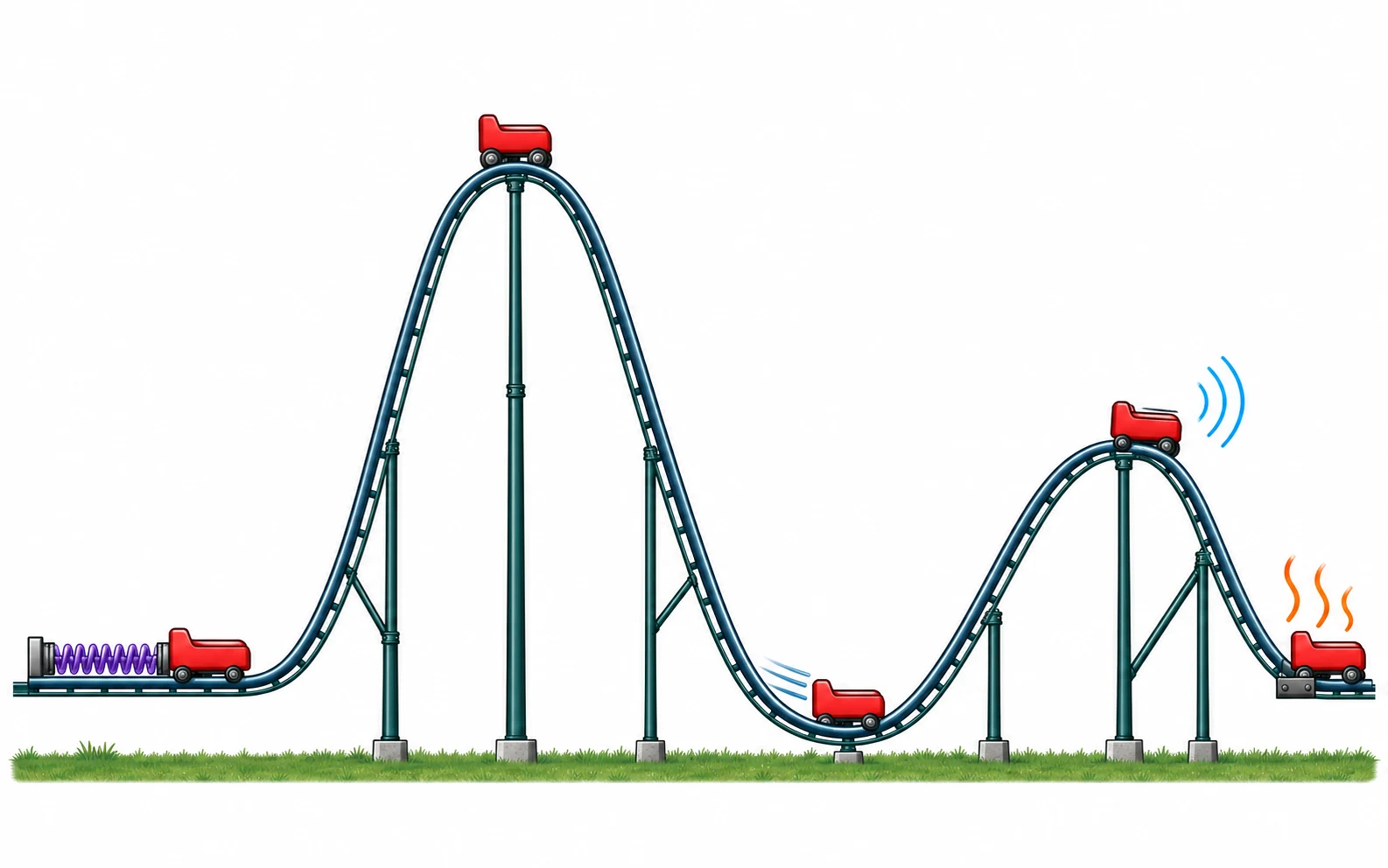
Label the Diagram: Energy on a roller coaster

Repeated red carts show successive positions on a supported track: beside a spring, atop a high hill, in a low valley, by curved sound marks, and at a brake with rising heat marks.

About this model: Repeated carts show the same cart at different moments. This is a qualitative model: energy spreads to the surroundings through friction and sound. No measured speeds or energy values are shown.

Original PotentELL science illustration

Students place 5 words on numbered spots: elastic potential energy, gravitational potential energy, kinetic energy, sound energy, thermal energy. They can turn on meanings and hear each word read aloud.

Teachers: open the same picture in ELLEvision to move labels, add words or audio, and publish your own version. ELLEvision needs a teacher sign-in.

Label the diagram

Break words into meaningful parts

Build It in ELLEments

Science words are often built from smaller parts. 6 words in this unit come with their parts ready, so students can hear each word, read it in a sentence, and build it from its pieces.

  • kinetic energykineticenergy

    A rolling bowling ball has a lot of kinetic energy.

  • potential energypotentialenergy

    A stretched rubber band has potential energy.

  • thermal energythermalenergy

    Rubbing your hands together makes thermal energy.

  • electrical energyelectricalenergy

    Batteries supply electrical energy to the flashlight.

  • radiant energyradiantenergy

    Solar panels capture radiant energy from the sun.

Tier 2 · Academic language

Words students need to talk and write about this unit

These are not science words, but students meet them in every task and question. Pre-teach them alongside the science words.

transform
To change from one form into another.
“A solar panel transforms light into electricity.”
convert
To change something into another form.
“Plants convert light energy into food energy.”
generate
To make or produce.
“A dam can generate electricity.”
apply
To use what you know in a new situation.
“Apply what you know about energy to design a better coaster.”
quantity
An amount that can be counted or measured.
“Compare the quantity of gravitational potential energy at each height.”
demonstrate
To show how something works.
“Demonstrate how a pendulum trades energy back and forth.”

Games and practice

Each game uses all 12 words. Find the Word is a word search; Sort It Out groups words by topic.

Flashcards

Flip through each word and its meaning.

Start

Definition Recall

Recite definitions as more words are hidden, with first-letter hints when you need help.

Start

Handwriting Practice

Write the word and definition on primary ruled paper, type and check what you wrote, and save a local image.

Start

Drag-and-Drop Match-Up

Drag each word onto its meaning.

Start

Multiple Choice Quiz

Choose the correct meaning for each word.

Start

Type the Term

Read a meaning and type the word.

Start

Find the Word

Search for the unit’s words in a letter grid.

Start

Crossword Puzzle

Solve a crossword using the meanings as clues.

Start

Spelling Practice

Hear each word, then spell it.

Start

Pronunciation Practice

Hear each word and practice saying it.

Start

Study guide

Words are grouped by the standard they support. Blue tiles show a word’s parts.

Kinetic & potential energy (6.PS.3)

energy
The ability to cause change or do work.Food gives your body energy.
kinetic energykineticenergy
The energy of motion. Faster or heavier objects have more.A rolling bowling ball has a lot of kinetic energy.
potential energypotentialenergy
Energy associated with the positions or arrangements of interacting objects or particles.A stretched rubber band has potential energy.
gravitational potential energy
Energy associated with the relative positions of masses; near Earth, raising an object above a chosen reference level increases it.A book on a high shelf has more gravitational potential energy than one on the floor.
elastic potential energy
Energy associated with stretching or compressing an object, such as a spring.A compressed spring has elastic potential energy.
chemical potential energy
Energy associated with the arrangement of atoms and electrons, which can change during a chemical reaction.Gasoline holds chemical potential energy.
thermal energythermalenergy
Energy associated with the random motion and interactions of particles in matter; it depends on the amount, type, and state of the material as well as its temperature.Rubbing your hands together makes thermal energy.
sound energy
Energy carried by vibrations moving through matter.A drum turns the drummer’s motion into sound energy.
electrical energyelectricalenergy
Energy carried by moving electric charges.Batteries supply electrical energy to the flashlight.
radiant energyradiantenergy
Energy carried by light and other electromagnetic waves.Solar panels capture radiant energy from the sun.
reference point
A chosen place or object used to describe position, motion, or height.We used the floor as the reference point for height.
transformationtransformation
A change from one form into another, like potential energy changing into kinetic energy.A falling ball shows an energy transformation.

See all grade 6 units in order