Back to all units

Grade 6 Science Vocabulary · Trimester 2, Unit 3

Matter

What matter is made of, how mass, volume, and density describe it, and how the motion of particles explains solids, liquids, gases, and changes of state.

Ohio science standards in this unit

  • 6.PS.1 · Atoms & matterMatter is made up of small particles called atoms.
  • 6.PS.2 · States of matterChanges of state are explained by a model of matter composed of particles that are in motion.

23 science words (Tier 3) and 6 academic words (Tier 2). Every word has a plain-language definition and an example sentence, written to support WIDA's Standard 4 (Science) English Language Development standard.

One word list, many ways to practice

These are the same 23 words, used in different tools. Students can start any of them right away. No student accounts or sign-in.

See the words in a picture

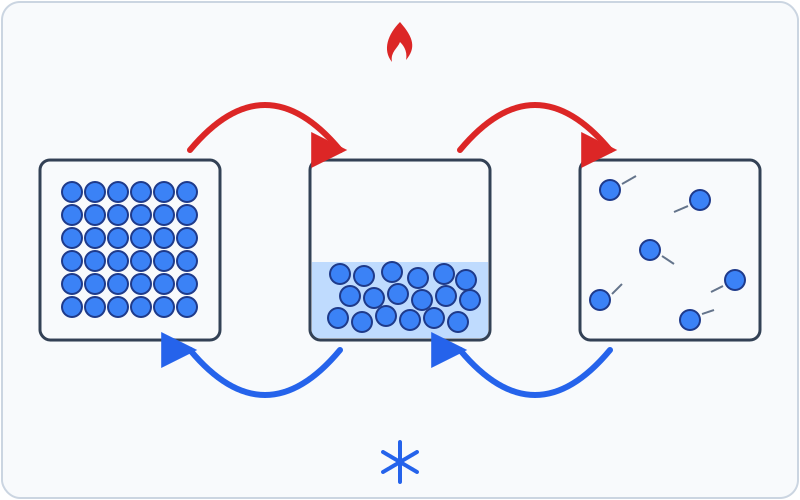
Label the Diagram: States of matter and phase changes

Three boxes of blue particles, tightly packed, loosely packed at the bottom, and spread out, joined by red arrows over the top and blue arrows underneath.

Students place 7 words on numbered spots: solid, liquid, gas, melting, evaporation, freezing, condensation. They can turn on meanings and hear each word read aloud.

Teachers: open the same picture in ELLEvision to move labels, add words or audio, and publish your own version. ELLEvision needs a teacher sign-in.

Label the diagram

Break words into meaningful parts

Build It in ELLEments

Science words are often built from smaller parts. 9 words in this unit come with their parts ready, so students can hear each word, read it in a sentence, and build it from its pieces.

  • water displacementwaterdisplacement

    We used water displacement to find the volume of the key.

  • densitydensity

    Oil floats because its density is lower than water’s.

  • particleparticle

    Each particle in a solid stays close to its neighbors.

  • compresscompress

    You can compress the air in a syringe, but not the water.

  • meltingmelting

    Melting turned the ice cube into a puddle.

Tier 2 · Academic language

Words students need to talk and write about this unit

These are not science words, but students meet them in every task and question. Pre-teach them alongside the science words.

describe
To tell what something is like.
“Describe how the particles move in each state of matter.”
compare
To look at how two or more things are alike and different.
“Compare the mass of two blocks that have the same volume.”
measure
To find the size or amount of something using a tool.
“Measure the mass and volume of each sample.”
property
A trait that describes a material and helps you tell it apart from others.
“Density is a property that can help identify a material.”
model
A drawing, object, or idea that shows how something works.
“Draw a model of the particles in a gas.”
evidence
Facts or observations that show something is true.
“The mass stayed the same, which is evidence that no particles were lost.”

Study guide

Words are grouped by the standard they support. Blue tiles show a word’s parts.

Atoms & matter (6.PS.1)

matter
Anything that has mass and takes up space.Air is matter even though you cannot see it.
atom
A particle of an element, far too small to see even with a microscope.Every atom of gold is the same kind of atom.
element
A substance made of only one kind of atom. It cannot be broken down into simpler substances.Oxygen is an element.
molecule
Two or more atoms joined together.A water molecule has two hydrogen atoms and one oxygen atom.
mass
How much matter is in an object.We measured the rock’s mass on a balance.
balance
A tool that measures mass by comparing an object with known masses.Set the cube on the balance and read its mass.
volume
How much space something takes up.The volume of the box is 1,000 cubic centimeters.
water displacementwaterdisplacement
Finding an object’s volume by measuring how much the water level rises when the object is dropped in.We used water displacement to find the volume of the key.
densitydensity
How much mass is packed into a certain volume.Oil floats because its density is lower than water’s.

States of matter (6.PS.2)

particleparticle
A very small piece of matter, such as an atom or molecule.Each particle in a solid stays close to its neighbors.
solid
Matter with a fixed shape and volume. Its particles are packed close and vibrate in place.Ice is a solid.
liquid
Matter with a fixed volume that takes the shape of its container. Its particles slide past each other.Juice is a liquid that fills the bottom of the cup.
gas
Matter with no fixed shape or volume. Its particles are far apart and move fast.Steam is water in the form of a gas.
compresscompress
To squeeze matter into a smaller space by pushing its particles closer together.You can compress the air in a syringe, but not the water.
temperature
A measure of how fast the particles in something are moving, on average.The temperature rose as the water heated up.
thermal energy
The total energy of all the moving particles in a substance. More mass or a higher temperature means more of it.A full bathtub of warm water has more thermal energy than a cup of it.
heat
Thermal energy moving from a warmer object to a cooler one.Heat flows from the hot cocoa into your cold hands.
phase change
Matter changing between solid, liquid, and gas. The particles change how they move and how far apart they are.Melting ice is a phase change.
meltingmelting
A solid changing into a liquid when it gains energy.Melting turned the ice cube into a puddle.
freezingfreezing
A liquid changing into a solid when it loses energy.Freezing turns pond water into ice.
evaporationevaporation
A liquid changing into a gas, usually at its surface.Evaporation dried the wet sidewalk.
boilingboiling
A liquid changing into a gas quickly, with bubbles forming all through it.Water starts boiling at 100 °C at sea level.
condensationcondensation
A gas changing into a liquid when it loses energy.Condensation formed drops on the cold glass.
See all grade 6 units in order