Back to all units

Grade 7 Science Vocabulary · Trimester 2, Topic 2.1

Thermal Energy Transfer

How thermal energy moves from warmer to cooler matter by conduction, convection, and radiation, and how conductors and insulators speed it up or slow it down.

Ohio science standards in this unit

  • 7.PS.4 · Energy transfer & wavesEnergy can be transferred through a variety of ways.

14 science words (Tier 3) and 6 academic words (Tier 2). Every word has a plain-language definition and an example sentence, written to support WIDA's Standard 4 (Science) English Language Development standard.

One word list, many ways to practice

These are the same 14 words, used in different tools. Students can start any of them right away. No student accounts or sign-in.

See the words in a picture

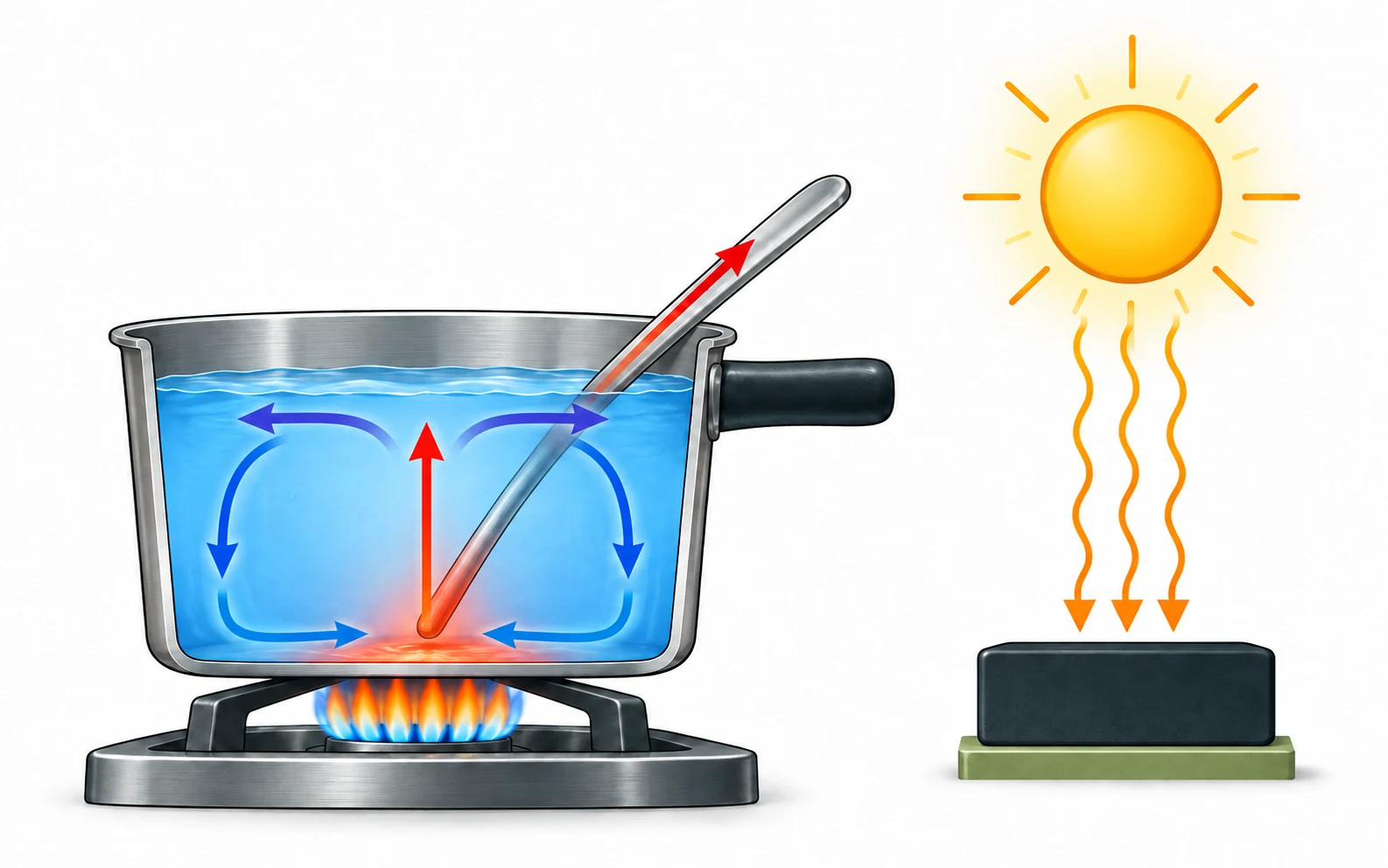
Label the Diagram: Three ways thermal energy moves

In a cutaway heated pot, water rises at the center, flows outward at the top, and sinks at the sides. An arrow follows a metal spoon outward. Sunlight arrows point down toward a dark block.

About this model: Red-to-blue convection arrows show relatively warmer water cooling away from the heated center; blue side arrows sink and the bottom return warms toward red. The arrows show directions, not measured temperatures or transfer rates. Several transfer processes can happen at the same time. An insulating handle slows energy transfer; it does not stop it completely.

Original PotentELL science illustration

Students place 5 words on numbered spots: conduction, convection, radiation, insulator, conductor. They can turn on meanings and hear each word read aloud.

Teachers: open the same picture in ELLEvision to move labels, add words or audio, and publish your own version. ELLEvision needs a teacher sign-in.

Label the diagram

Break words into meaningful parts

Build It in ELLEments

Science words are often built from smaller parts. 9 words in this unit come with their parts ready, so students can hear each word, read it in a sentence, and build it from its pieces.

  • thermal energythermalenergy

    A full bathtub of warm water holds a lot of thermal energy.

  • particleparticle

    Each particle moves faster when the water is hot.

  • conductionconduction

    Conduction made the metal spoon hot.

  • convectionconvection

    Convection carries warm air up to the ceiling.

  • radiationradiation

    You feel radiation from a campfire on your face.

Tier 2 · Academic language

Words students need to talk and write about this unit

These are not science words, but students meet them in every task and question. Pre-teach them alongside the science words.

plan
To decide the steps before you do something.
“Plan a test to compare three cups.”
implement
To put a plan into action.
“Implement your design and record the temperature.”
compare
To look at how two or more things are alike and different.
“Compare how fast the metal and wooden spoons warm up.”
data
Observations or measurements collected to investigate a question.
“Graph the temperature data every minute.”
rate
An amount per unit of another quantity, such as distance per second.
“Which cup has the slowest rate of cooling?”
explain
To make something clear by telling how or why it happens.
“Explain why the handle stays cool.”

Study guide

Words are grouped by the standard they support. Blue tiles show a word’s parts.

Energy transfer & waves (7.PS.4)

thermal energythermalenergy
Energy associated with the random motion and interactions of particles in matter; it depends on the amount, type, and state of the material as well as its temperature.A full bathtub of warm water holds a lot of thermal energy.
heat
Thermal energy moving from a warmer object to a cooler one.Heat flowed from the cocoa into my cold hands.
temperature
A measure of how hot or cold matter is, related to the average kinetic energy of its particles.The temperature of the soup dropped as it sat.
particleparticle
A very small piece of matter, such as an atom or molecule.Each particle moves faster when the water is hot.
conductionconduction
Transfer of thermal energy through interactions between neighboring particles, without flow of the material as a whole.Conduction made the metal spoon hot.
convectionconvection
Transfer of thermal energy by the bulk movement of a liquid or gas.Convection carries warm air up to the ceiling.
convection current
A circulation of fluid driven by density differences: less dense material rises and denser material sinks under gravity.A convection current keeps the soup moving in the pot.
radiationradiation
Transfer of energy by electromagnetic waves, which can travel through empty space.You feel radiation from a campfire on your face.
conductorconductor
A material that allows thermal energy or electric charge to move through it relatively easily; the context tells which property is meant.A metal pot is a good conductor.
insulatorinsulator
A material that strongly resists the transfer of thermal energy or the movement of electric charge; the context tells which property is meant.The plastic handle is an insulator, so it stays cool.
thermal equilibrium
A condition in which objects in thermal contact have the same temperature, so there is no net transfer of thermal energy between them.The ice water and the glass reached thermal equilibrium.
fluid
Any material that can flow, such as a liquid or a gas.Air is a fluid, so it can carry heat by moving.
absorbabsorb
To take in energy or matter.Dark pavement can absorb a lot of sunlight.
solar energysolarenergy
Energy that comes from the sun.A solar oven traps solar energy to cook food.
See all grade 7 units in order