Back to all units

Grade 7 Science Vocabulary · Trimester 1, Topic 1.6

Earth’s Spheres & the Water Cycle

How water moves through Earth’s four spheres, and how the land’s shape, soil, and rock control where water flows and what it carries.

Ohio science standards in this unit

  • 7.ESS.1 · Water cycleThe hydrologic cycle illustrates the changing states of water as it moves through the lithosphere, biosphere, hydrosphere and atmosphere.

22 science words (Tier 3) and 6 academic words (Tier 2). Every word has a plain-language definition and an example sentence, written to support WIDA's Standard 4 (Science) English Language Development standard.

One word list, many ways to practice

These are the same 22 words, used in different tools. Students can start any of them right away. No student accounts or sign-in.

See the words in a picture

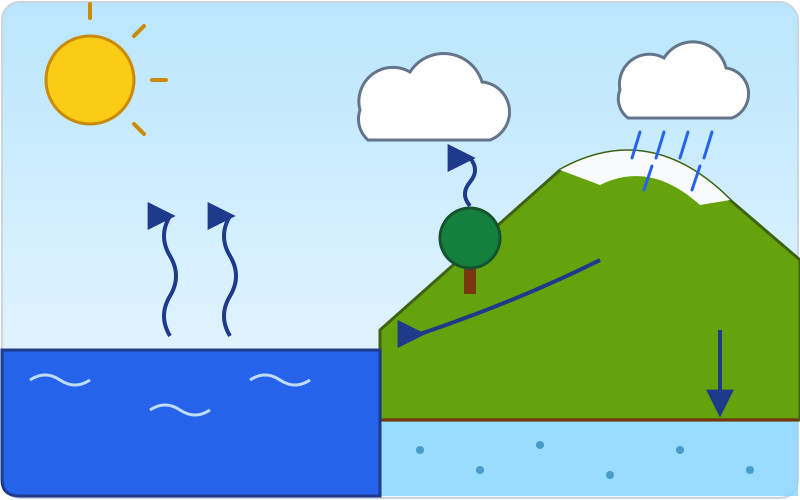
Label the Diagram: The water cycle

A sunny landscape with an ocean, a hill with a tree, two clouds, rain, and arrows showing water moving up, down, across, and into the ground.

Students place 8 words on numbered spots: evaporation, transpiration, condensation, precipitation, runoff, infiltration, ground water, surface water. They can turn on meanings and hear each word read aloud.

Teachers: open the same picture in ELLEvision to move labels, add words or audio, and publish your own version. ELLEvision needs a teacher sign-in.

Label the diagram

Break words into meaningful parts

Build It in ELLEments

Science words are often built from smaller parts. 15 words in this unit come with their parts ready, so students can hear each word, read it in a sentence, and build it from its pieces.

  • hydrologic cyclehydrologiccycle

    The sun’s energy drives the hydrologic cycle.

  • hydrospherehydrosphere

    Most of the hydrosphere is salt water in the oceans.

  • atmosphereatmosphere

    The atmosphere protects us from harmful sunlight.

  • lithospherelithosphere

    Mountains and soil are part of the lithosphere.

  • biospherebiosphere

    Forests, oceans, and cities are all part of the biosphere.

Tier 2 · Academic language

Words students need to talk and write about this unit

These are not science words, but students meet them in every task and question. Pre-teach them alongside the science words.

cycle
A set of events that repeats again and again in the same order.
“Water moves through the cycle again and again.”
transfer
To move from one place or thing to another.
“Thermal energy transfer happens each time water changes state.”
model
A drawing, object, or idea that shows how something works.
“Build a model of how water moves underground.”
impact
A strong effect on something.
“Describe the impact of a parking lot on runoff.”
describe
To tell what something is like using details.
“Describe how water moves through all four spheres.”
interpret
To figure out what information means.
“Interpret the map to find where the water will flow.”

Focused practice sets

Shorter word sets on one part of this unit, with extra activities and beginner support.

Hydrologic Cycle

Open the focused set and its activities.

Open set

Study guide

Words are grouped by the standard they support. Blue tiles show a word’s parts.

Water cycle (7.ESS.1)

hydrologic cyclehydrologiccycle
The nonstop movement of water between the land, the ocean, the air, and living things. Also called the water cycle.The sun’s energy drives the hydrologic cycle.
hydrospherehydrosphere
All of the water on Earth: oceans, lakes, rivers, ice, ground water, and water vapor.Most of the hydrosphere is salt water in the oceans.
atmosphereatmosphere
The layers of gases that surround Earth.The atmosphere protects us from harmful sunlight.
lithospherelithosphere
The solid, rocky outer layer of Earth.Mountains and soil are part of the lithosphere.
biospherebiosphere
All the living things on Earth and the places they live.Forests, oceans, and cities are all part of the biosphere.
spheres of Earth
The four connected parts of Earth: land, water, air, and living things.Water moves through all four spheres of Earth.
evaporationevaporation
Liquid water changing into water vapor, a gas.Evaporation dried the puddle on a sunny day.
condensationcondensation
Water vapor cooling and changing back into liquid drops.Condensation formed drops on the outside of the cold glass.
precipitationprecipitation
Water that falls from clouds as rain, snow, sleet, or hail.The forecast calls for heavy precipitation tonight.
transpiration
Plants releasing water vapor into the air through their leaves.On hot days, transpiration from trees adds water to the air.
sublimation
A solid changing straight into a gas without melting first.Snow can disappear by sublimation on cold, dry, sunny days.
infiltrationinfiltration
Water soaking down into the ground.Infiltration is faster in sandy soil than in clay.
runoffrunoff
Water that flows over the land surface instead of soaking in.Runoff from the parking lot carried oil into the creek.
ground watergroundwater
Water stored underground in the spaces between soil and rock.The town’s wells pump ground water.
surface watersurfacewater
Water above ground, such as in rivers, lakes, and oceans.Lake Erie is surface water.
aquiferaquifer
A layer of rock or sediment underground that holds and lets water move through it.The well reaches down into an aquifer.
porosity
How much open space a rock or soil has for holding water.Gravel has high porosity because it has big gaps.
permeabilitypermeability
How easily water can flow through rock or soil.Clay has low permeability, so water pools on top.
watershedwatershed
All the land that drains into one river or lake.Our school is in the Scioto River watershed.
topography
The shape of the land’s surface, including its hills, valleys, and slopes.The topography of the valley sends rain downhill into the river.
elevation
How high a place is above sea level.Water flows from high elevation to low elevation.
contamination
Making water, soil, or air unsafe by adding harmful substances.Fertilizer runoff caused contamination of the lake.
Warm-up words to review

Words from earlier grades that help with this unit.

water vapor
Water in the form of a gas.

See all grade 7 units in order