Back to all units

Grade 7 Science Vocabulary · Trimester 1, Topic 1.5

Circuits

How an electric circuit moves energy from a source to a device, and how current, voltage, and resistance change in series and parallel circuits.

Ohio science standards in this unit

  • 7.PS.4 · Energy transfer & wavesEnergy can be transferred through a variety of ways.

17 science words (Tier 3) and 6 academic words (Tier 2). Every word has a plain-language definition and an example sentence, written to support WIDA's Standard 4 (Science) English Language Development standard.

One word list, many ways to practice

These are the same 17 words, used in different tools. Students can start any of them right away. No student accounts or sign-in.

See the words in a picture

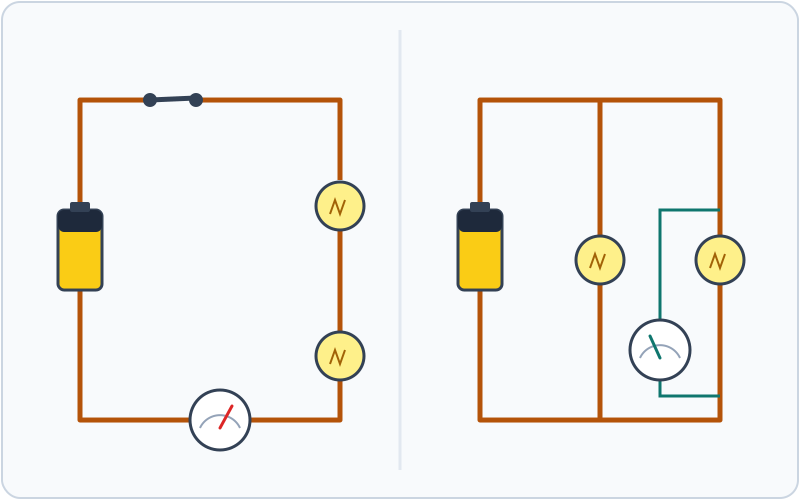
Label the Diagram: Two electric circuits

Two circuits side by side. On the left, one loop of wire with a battery, a switch, two bulbs, and a round meter. On the right, a battery with two bulbs on separate branches and a round meter wired across one bulb.

Students place 7 words on numbered spots: battery, switch, light bulb, series circuit, ammeter, parallel circuit, voltmeter. They can turn on meanings and hear each word read aloud.

Teachers: open the same picture in ELLEvision to move labels, add words or audio, and publish your own version. ELLEvision needs a teacher sign-in.

Label the diagram

Break words into meaningful parts

Build It in ELLEments

Science words are often built from smaller parts. 7 words in this unit come with their parts ready, so students can hear each word, read it in a sentence, and build it from its pieces.

  • voltagevoltage

    A car battery has a voltage of 12 volts.

  • resistanceresistance

    A thin wire has more resistance than a thick one.

  • conductorconductor

    Copper wire is a good conductor.

  • insulatorinsulator

    Rubber is a good insulator on wires.

  • ammeterammeter

    The ammeter showed 2 amperes.

Tier 2 · Academic language

Words students need to talk and write about this unit

These are not science words, but students meet them in every task and question. Pre-teach them alongside the science words.

construct
To build or put together.
“Construct a circuit that lights two bulbs.”
predict
To say what you think will happen, based on what you know.
“Predict what happens when you add a third bulb.”
observe
To watch carefully and notice details.
“Observe how bright each bulb is.”
effect
A change that happens because of something else.
“What is the effect of a longer wire?”
investigate
To study something carefully to find out about it.
“Investigate how resistance changes the current.”
record
To write down what you see or measure.
“Record the voltage for each bulb.”

Focused practice sets

Shorter word sets on one part of this unit, with extra activities and beginner support.

Electricity & Circuits

Open the focused set and its activities.

Open set

Study guide

Words are grouped by the standard they support. Blue tiles show a word’s parts.

Energy transfer & waves (7.PS.4)

electric circuit
A complete path that electricity can flow through.The bulb lit when we closed the electric circuit.
energy source
Something that supplies energy to a circuit, like a battery, generator, or solar cell.The battery is the energy source for the flashlight.
battery
A device that stores chemical energy and gives it out as electrical energy.The toy stopped when its battery ran down.
switch
A part that opens or closes a circuit.Flip the switch to turn on the light.
electric charge
A property of tiny particles that makes them push or pull on each other. Moving charges carry energy in a wire.Electric charge was already in the wire before the battery was connected.
closed circuit
A circuit with no breaks, so current flows.Flipping the switch on made a closed circuit.
open circuit
A circuit with a break, so current cannot flow.A burned-out bulb leaves an open circuit.
series circuit
A circuit with only one path, so every part shares the same current.In a series circuit, one broken bulb turns them all off.
parallel circuit
A circuit with more than one path for current.Your house is wired as a parallel circuit.
electric current
The flow of electric charge through a material, measured in amperes.Electric current flows from the battery through the wire.
voltagevoltage
The push that makes electric charge flow, measured in volts.A car battery has a voltage of 12 volts.
resistanceresistance
How much a material slows the flow of electric charge, measured in ohms.A thin wire has more resistance than a thick one.
conductorconductor
A material that lets electricity flow through it easily.Copper wire is a good conductor.
insulatorinsulator
A material that slows or stops the flow of electricity.Rubber is a good insulator on wires.
ammeterammeter
A tool that measures electric current.The ammeter showed 2 amperes.
voltmetervoltmeter
A tool that measures voltage.The voltmeter read 1.5 volts across the bulb.
light bulblightbulb
A device that changes electrical energy into light and heat.The light bulb glowed brighter with two batteries.
See all grade 7 units in order