Back to all units

Grade 7 Science Vocabulary · Trimester 2, Topic 2.2

Currents, Climate & the Atmosphere

How the sun’s energy drives currents in the ocean and the air, how those currents shape climate, and how the atmosphere changes from one layer to the next.

Ohio science standards in this unit

  • 7.ESS.2 · Currents & climateThermal-energy transfers in the ocean and the atmosphere contribute to the formation of currents, which influence global climate patterns.
  • 7.ESS.3 · The atmosphereThe atmosphere has different properties at different elevations and contains a mixture of gases that cycle through the lithosphere, biosphere, hydrosphere and atmosphere.

33 science words (Tier 3) and 6 academic words (Tier 2). Every word has a plain-language definition and an example sentence, written to support WIDA's Standard 4 (Science) English Language Development standard.

One word list, many ways to practice

These are the same 33 words, used in different tools. Students can start any of them right away. No student accounts or sign-in.

See the words in a picture

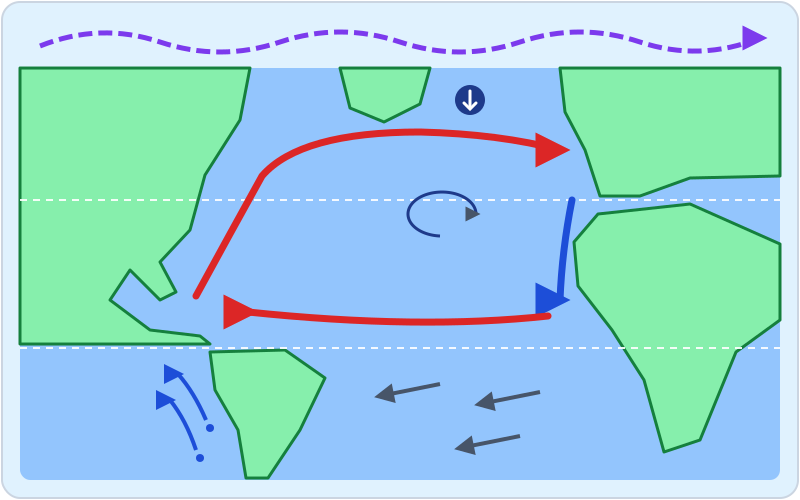
Label the Diagram: Ocean currents and winds

A map of an ocean between continents. A red arrow flows north along one coast and across the ocean, a blue arrow flows south along the other side, and a red arrow returns west, making a big loop. A purple wavy dashed arrow crosses the top, small gray arrows point west near a dashed line, blue arrows rise beside a southern coast, and a dark dot with a down arrow sits in the far north.

Students place 7 words on numbered spots: jet stream, Gulf Stream, gyre, density, global winds, upwelling, latitude. They can turn on meanings and hear each word read aloud.

Teachers: open the same picture in ELLEvision to move labels, add words or audio, and publish your own version. ELLEvision needs a teacher sign-in.

Label the diagram

Break words into meaningful parts

Build It in ELLEments

Science words are often built from smaller parts. 14 words in this unit come with their parts ready, so students can hear each word, read it in a sentence, and build it from its pieces.

  • upwellingupwelling

    Upwelling brings food for fish near the coast.

  • sea breezeseabreeze

    A cool sea breeze blew in every afternoon.

  • atmosphereatmosphere

    The atmosphere protects us from harmful sunlight.

  • tropospheretroposphere

    Clouds and storms form in the troposphere.

  • stratospherestratosphere

    Jets sometimes fly in the lower stratosphere.

Tier 2 · Academic language

Words students need to talk and write about this unit

These are not science words, but students meet them in every task and question. Pre-teach them alongside the science words.

pattern
Something that happens in a regular, repeated way.
“Ocean currents follow a pattern that circles each ocean.”
influence
To have an effect on something.
“Ocean currents influence the climate of coastal cities.”
analyze
To study the parts of something closely to understand it.
“Analyze the buoy data to find the warmest water.”
layer
One level of something that lies on top of another.
“Each layer of the atmosphere has its own temperature pattern.”
variation
A change or difference from one place or time to another.
“There is a big variation in temperature as you climb.”
explain
To make something clear by telling how or why it happens.
“Explain why cold water sinks below warm water.”

Focused practice sets

Shorter word sets on one part of this unit, with extra activities and beginner support.

Atmosphere

Open the focused set and its activities.

Open set

Study guide

Words are grouped by the standard they support. Blue tiles show a word’s parts.

Currents & climate (7.ESS.2)

climate
The usual weather of a place over many years.Ohio has a climate with cold winters and warm summers.
current
A steady flow of water in one direction, like a river inside the ocean.A warm current flows north along the coast.
density
How much mass is packed into a certain volume.Cold, salty water has a higher density, so it sinks.
salinity
How much salt is dissolved in water.The salinity of the Dead Sea is very high.
Coriolis effect
The curving of winds and ocean currents caused by Earth’s spin.The Coriolis effect bends winds to the right in the Northern Hemisphere.
global winds
Large wind patterns that blow steadily over long distances around Earth.Global winds push surface currents across the ocean.
jet stream
A fast, narrow band of wind high in the atmosphere.Planes flying east can ride the jet stream to save fuel.
Gulf Stream
A warm, fast ocean current that flows from the Gulf of Mexico up the east coast of North America.The Gulf Stream keeps parts of Europe milder in winter.
gyre
A huge, circling system of ocean currents.Floating trash collects in the middle of a gyre.
upwellingupwelling
Cold, nutrient-rich water rising from deep in the ocean to the surface.Upwelling brings food for fish near the coast.
El Niño
A pattern when the Pacific Ocean near South America becomes warmer than usual, changing weather around the world.During El Niño, some places get much more rain.
sea breezeseabreeze
A daytime wind that blows from the sea toward the warmer land.A cool sea breeze blew in every afternoon.
latitude
How far north or south a place is from the equator, measured in degrees.Places at a high latitude get less direct sunlight.
convection current
A loop of moving fluid where warm material rises and cool material sinks.Uneven heating sets up a convection current in the ocean.

The atmosphere (7.ESS.3)

atmosphereatmosphere
The layers of gases that surround Earth.The atmosphere protects us from harmful sunlight.
tropospheretroposphere
The lowest layer of the atmosphere, where we live and where weather happens.Clouds and storms form in the troposphere.
stratospherestratosphere
The layer above the lowest layer. It holds the ozone layer and gets warmer as you go up.Jets sometimes fly in the lower stratosphere.
mesospheremesosphere
The middle layer of the atmosphere, where most meteors burn up.A shooting star glows as it burns in the mesosphere.
thermospherethermosphere
A very high, thin layer that gets extremely hot from the sun’s energy. Auroras glow here.The space station orbits in the thermosphere.
exosphereexosphere
The outermost layer, where the air fades into space.Some satellites orbit in the exosphere.
ozone layer
A layer of ozone gas in the stratosphere that blocks most harmful ultraviolet (UV) light.The ozone layer acts like sunscreen for Earth.
tropopausetropopause
The boundary between the lowest layer of the atmosphere and the one above it.Temperature stops dropping at the tropopause.
altitude
Height above sea level.Air gets thinner as altitude increases.
air pressureairpressure
The push of the weight of air on everything around it.Air pressure is lower on top of a mountain.
barometerbarometer
A tool that measures air pressure.A falling barometer can mean a storm is coming.
composition
What something is made of and how much of each part it has.The composition of air is mostly nitrogen and oxygen.
nitrogen
The gas that makes up about 78% of the air.Most of the air you breathe in is nitrogen.
oxygen
The gas that makes up about 21% of the air. Animals need it to live.Plants release oxygen into the air.
carbon dioxide
A gas that plants take in and animals breathe out. It traps heat in the air.Burning fuel adds carbon dioxide to the air.
greenhouse gasgreenhousegas
A gas, such as carbon dioxide or water vapor, that traps heat near Earth’s surface.Methane is a strong greenhouse gas.
greenhouse effectgreenhouseeffect
The warming of Earth’s surface when gases in the air trap heat.Without the greenhouse effect, Earth would be frozen.
weather
The condition of the air at a certain time and place, like temperature, wind, and rain.The weather changed from sunny to stormy.
ultraviolet lightultravioletlight
Invisible light from the sun that can burn skin.Sunscreen helps block ultraviolet light.
See all grade 7 units in order