Back to all units

Grade 8 Science Vocabulary · Trimester 2, Unit 3

Species & Reproduction

How traits pass from parents to offspring through genes and alleles, how to predict offspring with a Punnett square, and how sexual and asexual reproduction compare.

Ohio science standards in this unit

  • 8.LS.3 · HeredityThe characteristics of an organism are a result of inherited traits received from parent(s).
  • 8.LS.2 · ReproductionEvery organism alive today comes from a long line of ancestors who reproduced successfully every generation.

25 science words (Tier 3) and 6 academic words (Tier 2). Every word has a plain-language definition and an example sentence, written to support WIDA's Standard 4 (Science) English Language Development standard.

One word list, many ways to practice

These are the same 25 words, used in different tools. Students can start any of them right away. No student accounts or sign-in.

See the words in a picture

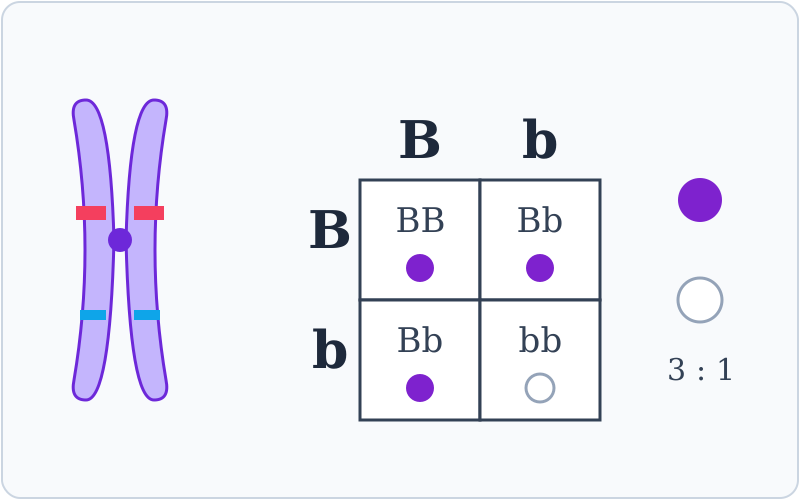
Label the Diagram: Chromosome and Punnett square

A purple X-shaped structure with colored bands beside a two-by-two chart of letter pairs, with purple and white circles that show flower colors.

Students place 7 words on numbered spots: chromosome, gene, dominant allele, recessive allele, homozygous, heterozygous, phenotype. They can turn on meanings and hear each word read aloud.

Teachers: open the same picture in ELLEvision to move labels, add words or audio, and publish your own version. ELLEvision needs a teacher sign-in.

Label the diagram

Break words into meaningful parts

Build It in ELLEments

Science words are often built from smaller parts. 9 words in this unit come with their parts ready, so students can hear each word, read it in a sentence, and build it from its pieces.

  • chromosomechromosome

    Each chromosome holds hundreds of genes.

  • genotypegenotype

    The genotype Bb means one of each allele.

  • phenotypephenotype

    Plants with BB and Bb have the same phenotype.

  • homozygoushomozygous

    A homozygous plant passes the same allele to every offspring.

  • heterozygousheterozygous

    A heterozygous plant can pass on either allele.

Tier 2 · Academic language

Words students need to talk and write about this unit

These are not science words, but students meet them in every task and question. Pre-teach them alongside the science words.

inherit
To receive something from a parent.
“You inherit half of your genes from each parent.”
predict
To say what you think will happen, based on what you know.
“Predict the traits of the offspring.”
explain
To make something clear by telling how or why it happens.
“Explain why siblings look different.”
compare
To look at how two or more things are alike and different.
“Compare asexual and sexual reproduction.”
unique
One of a kind; not like any other.
“Each person from sexual reproduction is genetically unique.”
bias
A one-sided view that can lead to an unfair conclusion.
“Check the article for bias before you trust it.”

Study guide

Words are grouped by the standard they support. Blue tiles show a word’s parts.

Heredity (8.LS.3)

heredity
The passing of traits from parents to offspring.Heredity explains why you have your mother’s eye color.
trait
A feature of an organism, like eye color or leaf shape.Freckles are an inherited trait.
chromosomechromosome
A thread-like structure in the nucleus made of DNA that carries genes.Each chromosome holds hundreds of genes.
gene
A section of DNA that carries instructions for a trait.One gene controls whether pea seeds are round or wrinkled.
allele
One form of a gene, such as the form for purple flowers or white flowers.Each parent passes one allele for each gene.
dominant allele
A form of a gene that shows its trait even if only one copy is present. Shown with a capital letter.The dominant allele B gives purple flowers.
recessive allele
A form of a gene whose trait shows only when two copies are present. Shown with a lowercase letter.A plant needs two copies of the recessive allele b to have white flowers.
genotypegenotype
The two alleles an organism has for a gene, like BB, Bb, or bb.The genotype Bb means one of each allele.
phenotypephenotype
The trait you can see or measure, like purple flowers.Plants with BB and Bb have the same phenotype.
homozygoushomozygous
Having two identical alleles for a gene, like BB or bb.A homozygous plant passes the same allele to every offspring.
heterozygousheterozygous
Having two different alleles for a gene, like Bb.A heterozygous plant can pass on either allele.
Punnett square
A chart used to predict the possible genotypes of offspring.The Punnett square showed a 1 in 4 chance of white flowers.
probabilityprobability
How likely it is that something will happen.The probability of a white-flowered plant is 25%.
co-dominance
When both alleles show in the offspring, like a flower with red and white patches.Co-dominance gave the cow red and white hairs.
Reproduction (8.LS.2)

asexual reproductionasexualreproduction
Making offspring from one parent. The offspring are identical to the parent.A strawberry plant can make new plants by asexual reproduction.
sexual reproduction
Making offspring from two parents, each giving half of the genetic information.Sexual reproduction mixes traits from both parents.
offspringoffspring
The young of a living thing.The cat had four offspring.
gamete
A sex cell, like a sperm or egg, with half the usual number of chromosomes.Each gamete carries one copy of every chromosome.
fertilizationfertilization
A sperm cell and an egg cell joining to start a new organism.Fertilization happens inside the flower.
zygote
The first cell of a new organism, formed by fertilization.The zygote divides again and again.
meiosis
Cell division that makes sex cells with half the usual number of chromosomes.Meiosis makes four egg or sperm cells from one cell.
mitosis
Cell division that makes two cells identical to the first.Mitosis helps a body grow.
clone
An organism with exactly the same genes as its single parent.A plant grown from a cutting is a clone.
bacteria
Tiny one-celled organisms. Many reproduce by splitting in two.Bacteria can double in number every 20 minutes.
genetic modification
Changing an organism’s genes on purpose using technology.Genetic modification made this corn resist insects.

See all grade 8 units in order