Back to all units

Grade 8 Science Vocabulary · Trimester 3, Unit 4

Evidence of Change

How rock layers, fossils, and ice cores record Earth’s history, how species change or die out over many generations, and how constructive and destructive processes shape the land.

Ohio science standards in this unit

  • 8.ESS.4 · Geologic recordEvidence of the dynamic changes of Earth's surface through time is found in the geologic record.
  • 8.LS.1 · Fossils & change over timeDiversity of species, a result of variation of traits, occurs through the process of evolution and extinction over many generations. The fossil records provide evidence that changes have occurred in number and types of species.
  • 8.ESS.3 · Shaping the surfaceA combination of constructive and destructive geologic processes formed Earth's surface.

37 science words (Tier 3) and 6 academic words (Tier 2). Every word has a plain-language definition and an example sentence, written to support WIDA's Standard 4 (Science) English Language Development standard.

One word list, many ways to practice

These are the same 37 words, used in different tools. Students can start any of them right away. No student accounts or sign-in.

See the words in a picture

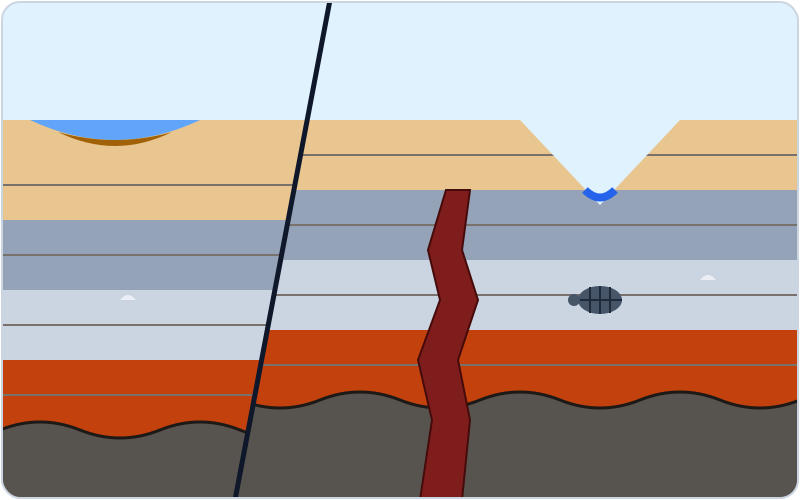
Label the Diagram: Rock layers

A cut through stacked rock layers with a lake on top at the left, a river valley at the right, a dark line breaking the layers, a red band of rock cutting upward, a fossil, and a wavy boundary near the bottom.

Students place 6 words on numbered spots: fault, igneous intrusion, index fossil, unconformity, erosion, deposition. They can turn on meanings and hear each word read aloud.

Teachers: open the same picture in ELLEvision to move labels, add words or audio, and publish your own version. ELLEvision needs a teacher sign-in.

Label the diagram

Break words into meaningful parts

Build It in ELLEments

Science words are often built from smaller parts. 14 words in this unit come with their parts ready, so students can hear each word, read it in a sentence, and build it from its pieces.

  • geologic recordgeologicrecord

    The geologic record shows that Ohio was once under a sea.

  • crosscutting relationshipscrosscuttingrelationships

    Crosscutting relationships tell us the fault came last.

  • unconformityunconformity

    The wavy line in the cliff is an unconformity.

  • paleoclimatepaleoclimate

    Coal layers tell us the paleoclimate was warm and swampy.
  • variationvariation

    Variation in beak size helped some birds survive.

Tier 2 · Academic language

Words students need to talk and write about this unit

These are not science words, but students meet them in every task and question. Pre-teach them alongside the science words.

sequence
The order in which things happen.
“Put the rock layers in sequence from oldest to youngest.”
evidence
Facts or observations that show something is true.
“Fossils are evidence of past life.”
interpret
To figure out what information means.
“Interpret the rock layers to tell the area’s history.”
design
To plan how to build or test something.
“Design a model that shows erosion by water.”
explain
To make something clear by telling how or why it happens.
“Explain how a glacier shapes the land.”
use
To put something to work for a purpose.
“Use the map to find the steepest slope.”

Study guide

Words are grouped by the standard they support. Blue tiles show a word’s parts.

Geologic record (8.ESS.4)

geologic recordgeologicrecord
The history of Earth that is preserved in rock layers and fossils.The geologic record shows that Ohio was once under a sea.
law of superposition
The rule that in undisturbed rock layers, the oldest layer is at the bottom and the youngest is at the top.By the law of superposition, the bottom layer formed first.
relative age
Whether a rock or event is older or younger than another, without an exact number of years.We found the relative age of each layer by its position.
absolute age
The actual age of a rock or fossil in years.Scientists measured the absolute age of the ash layer.
radiometric dating
Finding a rock’s age in years by measuring how much of a radioactive element has changed.Radiometric dating showed the rock was 450 million years old.
index fossil
A fossil of a species that lived for a short time over a wide area, used to date rock layers.Trilobites are a useful index fossil.
fossil
The preserved remains or traces of a living thing from long ago.We found a shell fossil in the limestone.
fault
A crack in Earth’s crust where rocks have moved.The layers on each side of the fault no longer line up.
igneous intrusion
Magma that pushed into other rock and hardened underground. It is younger than the rock it cuts.The igneous intrusion cuts across three older layers.
crosscutting relationshipscrosscuttingrelationships
The rule that a feature cutting across rock layers is younger than the layers it cuts.Crosscutting relationships tell us the fault came last.
unconformityunconformity
A gap in the rock record where layers were worn away before new ones formed.The wavy line in the cliff is an unconformity.
geologic time scale
A timeline that divides Earth’s history into eras and periods.Dinosaurs appear late on the geologic time scale.
ice core
A long tube of ice drilled from a glacier that holds clues about past climate.Air bubbles in the ice core show past carbon dioxide levels.
paleoclimatepaleoclimate
The climate of a place long ago.Coal layers tell us the paleoclimate was warm and swampy.

Fossils & change over time (8.LS.1)

species
A group of organisms that can mate and have offspring that can also have offspring.Lions and tigers are different species.
variationvariation
Differences in traits among members of the same species.Variation in beak size helped some birds survive.
diversitydiversity
The number of different kinds of living things in an area.Coral reefs have great diversity.
adaptationadaptation
A trait that helps an organism survive and reproduce in its environment.Thick fur is an adaptation to cold weather.
natural selection
The process in which organisms with helpful traits survive and reproduce more, so those traits become common.Natural selection favored moths that blended in with tree bark.
evolution
Change in a species over many generations.Fossils show the evolution of whales from land animals.
extinctionextinction
When every member of a species has died.An asteroid led to the extinction of most dinosaurs.
fossil record
All the fossils found so far and what they tell us about life in the past.The fossil record shows that life has changed over time.
transitional form
A species that shows features partway between an older group and the newer group that came from it.A fossil of a fish with leg-like fins is a transitional form.
common ancestor
An earlier species that two or more later species came from.Horses and zebras share a common ancestor.

Shaping the surface (8.ESS.3)

constructive processconstructiveprocess
A natural process that builds up land, such as a volcano erupting or sediment piling up.A lava flow is a constructive process that adds new land.
destructive processdestructiveprocess
A natural process that wears away or destroys land, such as erosion or a landslide.A landslide is a destructive process.
erosion
The moving of rock and soil from one place to another by water, wind, ice, or gravity.Erosion by the river carved a canyon.
depositiondeposition
The dropping of rock pieces in a new place after they have been moved.Deposition at the river mouth built a delta.
landformlandform
A natural shape on Earth’s surface, such as a mountain, valley, or plain.A canyon is a landform made by a river.
glacier
A huge mass of ice that moves slowly over land.A glacier flattened much of northern Ohio.
flood plain
Flat land beside a river that is covered with water when the river floods.Rich soil collects on the flood plain.
delta
A fan of sediment that builds up where a river enters a lake or ocean.The Mississippi River ends in a large delta.
upliftuplift
The raising of land to a higher level by forces inside Earth.Uplift raised old sea-floor rock into mountains.
elevation
How high a place is above sea level.Campbell Hill has the highest elevation in Ohio.
topographic maptopographicmap
A map that uses lines to show the shape and height of the land.The topographic map showed a steep hill.
contour line
A line on a map that connects points at the same height.Contour lines close together mean a steep slope.
aerial map
A map made from photos taken from high above the ground.The aerial map showed the new houses by the river.

See all grade 8 units in order