Back to all units

Grade 7 Science Vocabulary · Trimester 1, Topic 1.3

Waves

How mechanical and electromagnetic waves carry energy, and how to describe a wave by its wavelength, amplitude, and frequency.

Ohio science standards in this unit

  • 7.PS.4 · Energy transfer & wavesEnergy can be transferred through a variety of ways.

20 science words (Tier 3) and 6 academic words (Tier 2). Every word has a plain-language definition and an example sentence, written to support WIDA's Standard 4 (Science) English Language Development standard.

One word list, many ways to practice

These are the same 20 words, used in different tools. Students can start any of them right away. No student accounts or sign-in.

See the words in a picture

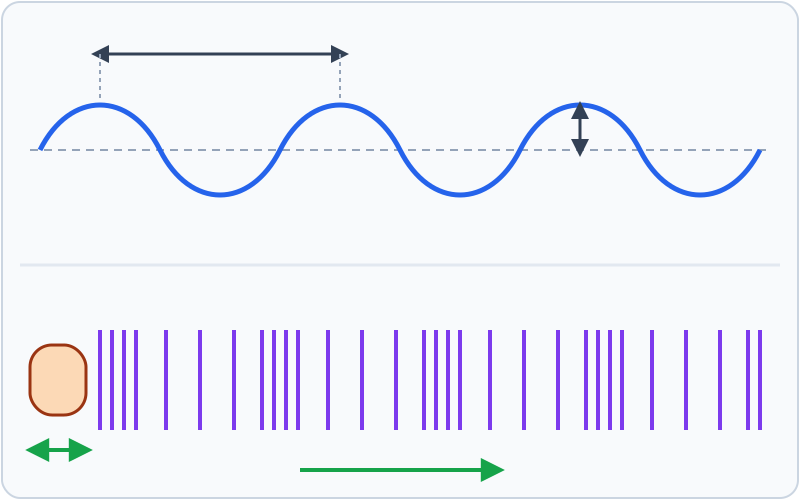
Label the Diagram: Two kinds of waves

At the top, a blue wave curving above and below a dashed center line, with a measuring arrow above it and a short up-and-down arrow. At the bottom, a hand pushing a row of purple coils that are bunched together in some places and spread out in others, with an arrow pointing right.

Students place 8 words on numbered spots: crest, trough, wavelength, amplitude, transverse wave, compression, rarefaction, longitudinal wave. They can turn on meanings and hear each word read aloud.

Teachers: open the same picture in ELLEvision to move labels, add words or audio, and publish your own version. ELLEvision needs a teacher sign-in.

Label the diagram

Break words into meaningful parts

Build It in ELLEments

Science words are often built from smaller parts. 8 words in this unit come with their parts ready, so students can hear each word, read it in a sentence, and build it from its pieces.

  • vibrationvibration

    The vibration of a guitar string makes sound.

  • electromagnetic waveelectromagneticwave

    Sunlight reaches Earth as an electromagnetic wave.

  • transverse wavetransversewave

    Shaking a rope up and down makes a transverse wave.

  • compressioncompression

    Each push of the spring sends a compression down the coil.

  • wavelengthwavelength

    Red light has a longer wavelength than blue light.

Tier 2 · Academic language

Words students need to talk and write about this unit

These are not science words, but students meet them in every task and question. Pre-teach them alongside the science words.

transfer
To move from one place or thing to another.
“Waves transfer energy without moving matter far.”
describe
To tell what something is like using details.
“Describe how the wave changes when you shake faster.”
compare
To tell how things are alike and different.
“Compare a sound wave with a light wave.”
relationship
The way two things are connected.
“What is the relationship between frequency and wavelength?”
direction
The way something moves or points.
“The rope moves up and down, but the wave travels in another direction.”
represent
To show or stand for something.
“The blue line represents a wave on a rope.”

Focused practice sets

Shorter word sets on one part of this unit, with extra activities and beginner support.

Electromagnetic Spectrum

Open the focused set and its activities.

Open set

Study guide

Words are grouped by the standard they support. Blue tiles show a word’s parts.

Energy transfer & waves (7.PS.4)

wave
A disturbance that carries energy from place to place.A wave moved across the pond.
vibrationvibration
A quick back-and-forth or up-and-down motion.The vibration of a guitar string makes sound.
medium
The material a wave travels through, like air or water.Sound needs a medium, so it cannot travel through space.
vacuum
Space with no matter in it, not even air.Light can travel through a vacuum, but sound cannot.
mechanical wave
A wave, like sound or a water wave, that needs matter to travel through.An ocean wave is a mechanical wave.
electromagnetic waveelectromagneticwave
A wave, like light or radio, that can travel through empty space.Sunlight reaches Earth as an electromagnetic wave.
transverse wavetransversewave
A wave that moves matter up and down while the wave travels sideways.Shaking a rope up and down makes a transverse wave.
longitudinal wave
A wave that pushes matter back and forth in the same direction the wave travels.Sound is a longitudinal wave.
compressioncompression
The part of a push-and-pull wave where the particles are squeezed close together.Each push of the spring sends a compression down the coil.
rarefaction
The part of a push-and-pull wave where the particles are spread far apart.Behind each squeezed part of the spring is a rarefaction.
crest
The highest point of a wave.The surfer rode the crest of the wave.
trough
The lowest point of a wave.The boat dipped into the trough between waves.
wavelengthwavelength
The distance from one high point of a wave to the next.Red light has a longer wavelength than blue light.
amplitude
How far a wave moves up or down from its resting position. Bigger means more energy.Loud sounds have a large amplitude.
frequency
How many waves pass a point each second.A high whistle has a high frequency.
wave speed
How fast a wave moves through a material.Wave speed is faster for sound in steel than in air.
pitch
How high or low a sound seems.A small bell has a higher pitch than a large one.
reflectionreflection
A wave bouncing off a surface.An echo is a reflection of sound.
refractionrefraction
A wave bending as it passes from one material into another.Refraction makes a straw look broken in water.
absorptionabsorption
A material taking in a wave’s energy.Dark shirts warm up from absorption of sunlight.
See all grade 7 units in order