Back to all units

Grade 7 Science Vocabulary · Trimester 3, Topic 3.1

The Seasons

Why Earth has seasons: the tilt of its axis changes the angle of sunlight and the number of daylight hours as Earth orbits the sun.

Ohio science standards in this unit

  • 7.ESS.5 · SeasonsThe relative positions of Earth and the sun cause patterns we call seasons.

16 science words (Tier 3) and 6 academic words (Tier 2). Every word has a plain-language definition and an example sentence, written to support WIDA's Standard 4 (Science) English Language Development standard.

One word list, many ways to practice

These are the same 16 words, used in different tools. Students can start any of them right away. No student accounts or sign-in.

See the words in a picture

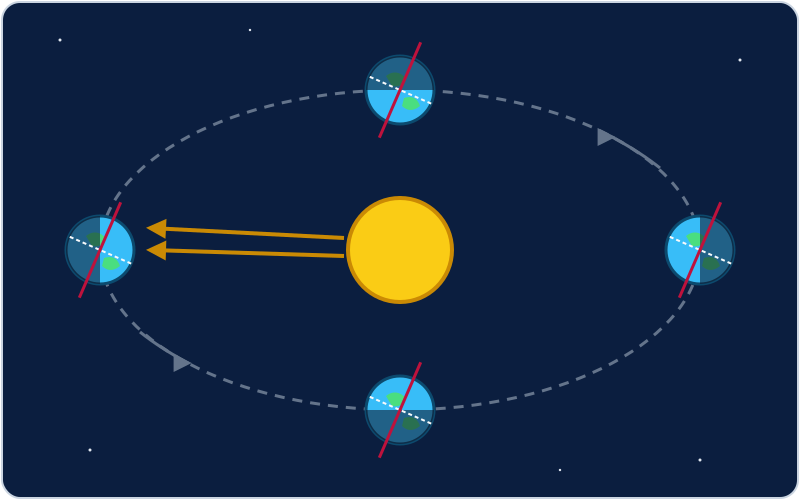
Label the Diagram: Earth’s tilt and the seasons

The sun in the middle of a dashed oval path. Earth is shown at four places on the path, always tilted the same way, with its night side shaded. Two arrows point from the sun to the Earth on the left.

Students place 6 words on numbered spots: orbit, axis, equator, equinox, solstice, direct rays. They can turn on meanings and hear each word read aloud.

Teachers: open the same picture in ELLEvision to move labels, add words or audio, and publish your own version. ELLEvision needs a teacher sign-in.

Label the diagram

Break words into meaningful parts

Build It in ELLEments

Science words are often built from smaller parts. 6 words in this unit come with their parts ready, so students can hear each word, read it in a sentence, and build it from its pieces.

  • hemispherehemisphere

    When it is summer in our hemisphere, it is winter in Australia.

  • equinoxequinox

    The fall equinox comes in late September.

  • revolutionrevolution

    One revolution of Earth around the sun is a year.

  • equatorequator

    Places near the equator are warm all year.

  • daylightdaylight

    Ohio gets about 15 hours of daylight in June.

Tier 2 · Academic language

Words students need to talk and write about this unit

These are not science words, but students meet them in every task and question. Pre-teach them alongside the science words.

position
Where something is compared to other things.
“Earth’s position in its orbit changes through the year.”
relative
Compared to something else.
“Describe Earth’s tilt relative to the sun.”
demonstrate
To show how something works.
“Use a globe and a lamp to demonstrate the seasons.”
cause
What makes something happen.
“The tilt of Earth is the cause of the seasons.”
region
A large area with something in common.
“Some regions have a rainy season instead of winter.”
support
To give reasons or evidence that something is true.
“Use data to support your answer.”

Focused practice sets

Shorter word sets on one part of this unit, with extra activities and beginner support.

Seasons

Open the focused set and its activities.

Open set

Study guide

Words are grouped by the standard they support. Blue tiles show a word’s parts.

Seasons (7.ESS.5)

axis
An imaginary line through the center of Earth from the North Pole to the South Pole. Earth spins around it.Earth’s axis is tilted 23.5 degrees.
tilt
A slant or lean away from straight up and down.The tilt of Earth causes the seasons.
season
A part of the year with its own weather pattern: winter, spring, summer, or fall.Summer is the warmest season in Ohio.
hemispherehemisphere
Half of Earth, such as the northern half or southern half.When it is summer in our hemisphere, it is winter in Australia.
solstice
The day with the most or the least daylight of the year.The June solstice is the longest day of the year in Ohio.
equinoxequinox
One of two days each year when day and night are about the same length everywhere.The fall equinox comes in late September.
direct rays
Sunlight that hits the ground straight on, so its energy is concentrated in a small area.Direct rays make summer days hot.
monsoon
A seasonal wind that brings a very rainy season to some regions, such as India.The summer monsoon brings heavy rain to India.
indirect rays
Sunlight that hits the ground at a low slant, so its energy is spread over a large area.Indirect rays make winter days cold.
orbit
The curved path one object takes around another in space.Earth’s orbit around the sun takes one year.
revolutionrevolution
One full trip of an object around another object.One revolution of Earth around the sun is a year.
equatorequator
An imaginary line around the middle of Earth, halfway between the poles.Places near the equator are warm all year.
daylightdaylight
The hours when the sun is above the horizon.Ohio gets about 15 hours of daylight in June.
angle
How much a line slants compared to another line.The angle of the sun is higher in summer.
intensityintensity
How strong or concentrated something is.Direct sunlight has a higher intensity than slanted sunlight.
climate
The usual weather of a place over many years.Seasonal changes are part of a place’s climate.
See all grade 7 units in order