Back to all units

Grade 7 Science Vocabulary · Trimester 1, Topic 1.1

Changing Matter

How matter can be mixed, separated, or changed into new substances, and why the number and type of atoms (and the mass) stay the same in a closed system.

Ohio science standards in this unit

  • 7.PS.2 · Conservation of massMatter can be separated or changed, but in a closed system, the number and types of atoms remains constant.

20 science words (Tier 3) and 6 academic words (Tier 2). Every word has a plain-language definition and an example sentence, written to support WIDA's Standard 4 (Science) English Language Development standard.

One word list, many ways to practice

These are the same 20 words, used in different tools. Students can start any of them right away. No student accounts or sign-in.

See the words in a picture

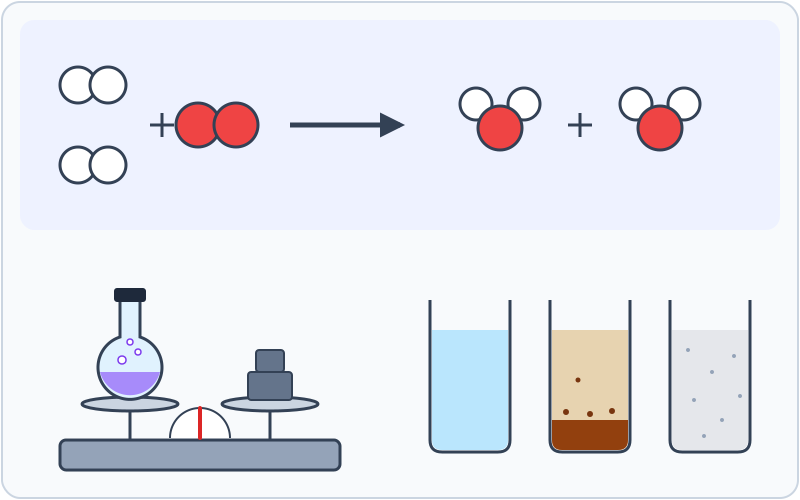
Label the Diagram: Changing matter

Atom models joining into new molecules across an arrow, a sealed flask on a level balance, and three beakers: one clear, one with dirt settled at the bottom, and one cloudy white.

Students place 7 words on numbered spots: reactant, product, closed system, conservation of mass, solution, suspension, colloid. They can turn on meanings and hear each word read aloud.

Teachers: open the same picture in ELLEvision to move labels, add words or audio, and publish your own version. ELLEvision needs a teacher sign-in.

Label the diagram

Break words into meaningful parts

Build It in ELLEments

Science words are often built from smaller parts. 4 words in this unit come with their parts ready, so students can hear each word, read it in a sentence, and build it from its pieces.

  • compoundcompound

    Table salt is a compound of sodium and chlorine.

  • mixturemixture

    Salad is a mixture you can pick apart.

  • dissolvedissolve

    Sugar will dissolve in warm tea.

  • reactantreactant

    In the equation, hydrogen and oxygen are the reactants.

Tier 2 · Academic language

Words students need to talk and write about this unit

These are not science words, but students meet them in every task and question. Pre-teach them alongside the science words.

separate
To pull apart or keep apart.
“Use a filter to separate the sand from the water.”
measure
To find the size or amount of something using a tool.
“Measure the mass before and after the reaction.”
constant
Staying the same.
“The total mass stays constant in a closed system.”
evidence
Facts or observations that show something is true.
“Bubbles are evidence of a chemical change.”
identify
To find and name something.
“Identify the reactants in the equation.”
explain
To make something clear by telling how or why it happens.
“Explain why the sealed bag weighs the same.”

Study guide

Words are grouped by the standard they support. Blue tiles show a word’s parts.

Conservation of mass (7.PS.2)

atom
The smallest unit of an element.Every atom of gold is the same kind of atom.
element
A pure substance made of only one kind of atom.Oxygen is an element.
compoundcompound
A substance made of two or more elements joined together chemically, like water (H₂O).Table salt is a compound of sodium and chlorine.
molecule
Two or more atoms joined together.A water molecule has two hydrogen atoms and one oxygen atom.
mixturemixture
Two or more substances mixed together but not joined chemically, like trail mix or salt water.Salad is a mixture you can pick apart.
solution
A mixture where one substance dissolves evenly into another, like sugar in water.Salt water is a solution.
suspension
A mixture with particles big enough to settle out if it sits, like muddy water.Muddy water is a suspension, so the dirt sinks over time.
colloid
A mixture with tiny particles that stay spread out and do not settle, like milk or fog.Milk is a colloid.
dissolvedissolve
To break apart and spread evenly through a liquid.Sugar will dissolve in warm tea.
physical change
A change in size, shape, or state that does not make a new substance.Cutting paper is a physical change.
chemical change
A change that makes a new substance, like burning or rusting.Baking a cake is a chemical change.
chemical reaction
A process in which substances turn into new substances.A chemical reaction made the steel wool rust.
reactantreactant
A substance you start with in a chemical reaction.In the equation, hydrogen and oxygen are the reactants.
product
A new substance that forms in a chemical reaction.Water is the product when hydrogen burns.
chemical equation
A short way to write a chemical reaction using symbols, showing what you start with and what forms.The chemical equation shows two hydrogen molecules and one oxygen molecule forming water.
conservation of mass
The rule that matter is not created or destroyed in a change, so the total mass stays the same.Because of conservation of mass, the sealed bag weighed the same before and after.
closed system
A system where no matter can get in or out.A sealed jar is a closed system.
open system
A system where matter can move in and out.An open cup of fizzing soda is an open system, so gas escapes.
mass
How much matter is in an object.We measured the rock’s mass on a balance.
volume
How much space something takes up. It is not always kept the same when substances mix.Mixing alcohol and water gives a volume a little less than the two added together.
Warm-up words to review

Words from earlier grades that help with this unit.

matter
Anything that has mass and takes up space.

See all grade 7 units in order