Back to all units

Grade 7 Science Vocabulary · Trimester 3, Topic 3.3

Biomes

How biotic and abiotic factors shape each of Earth’s biomes, and what limits how many organisms a biome can support.

Ohio science standards in this unit

  • 7.LS.2 · BiomesIn any particular biome, the number, growth and survival of organisms and populations depend on biotic and abiotic factors.

19 science words (Tier 3) and 6 academic words (Tier 2). Every word has a plain-language definition and an example sentence, written to support WIDA's Standard 4 (Science) English Language Development standard.

One word list, many ways to practice

These are the same 19 words, used in different tools. Students can start any of them right away. No student accounts or sign-in.

See the words in a picture

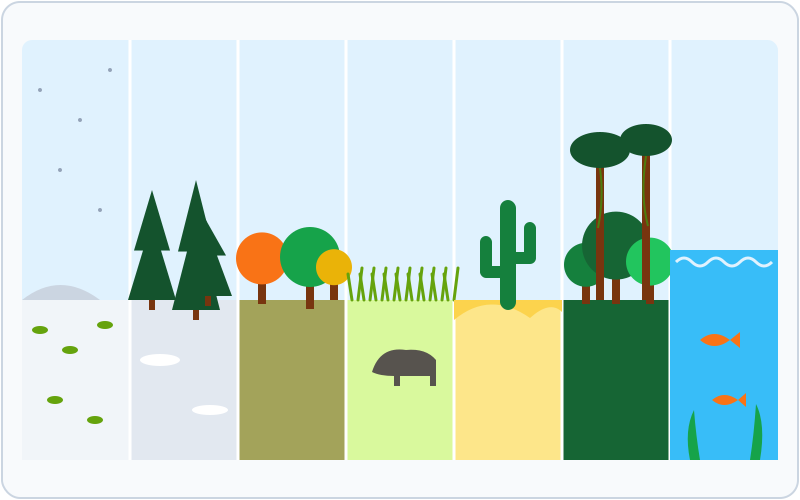
Label the Diagram: Seven biomes side by side

Seven side-by-side scenes: pale ground with low shrubs, dark pointed evergreens with snow, round trees in fall colors, tall grass with a bison, sand with a cactus, a dense forest with tall trees and vines, and water with fish and seaweed.

Students place 7 words on numbered spots: tundra, taiga, temperate forest, grassland, desert, tropical rain forest, aquatic biome. They can turn on meanings and hear each word read aloud.

Teachers: open the same picture in ELLEvision to move labels, add words or audio, and publish your own version. ELLEvision needs a teacher sign-in.

Label the diagram

Break words into meaningful parts

Build It in ELLEments

Science words are often built from smaller parts. 5 words in this unit come with their parts ready, so students can hear each word, read it in a sentence, and build it from its pieces.

  • ecosystemecosystem

    A pond is a small ecosystem.

  • biotic factorbioticfactor

    Trees are a biotic factor in a forest.

  • abiotic factorabioticfactor

    Rainfall is an abiotic factor.

  • biodiversitybiodiversity

    A tropical rain forest has high biodiversity.

  • grasslandgrassland

    Bison once roamed the grassland.

Tier 2 · Academic language

Words students need to talk and write about this unit

These are not science words, but students meet them in every task and question. Pre-teach them alongside the science words.

compare
To tell how things are alike and different.
“Compare the rainfall in the desert and the rain forest.”
impact
A strong effect on something.
“Describe the impact of a drought on the grassland.”
depend
To need something or someone in order to survive.
“Moose depend on the taiga’s trees for food.”
factor
One of the things that causes a result.
“Temperature is one factor that shapes a biome.”
data
Facts and numbers collected to learn something.
“Use the data to graph the deer population.”
identify
To find and name something.
“Identify the living and nonliving parts of the pond.”

Focused practice sets

Shorter word sets on one part of this unit, with extra activities and beginner support.

Biome Dynamics

Open the focused set and its activities.

Open set

Study guide

Words are grouped by the standard they support. Blue tiles show a word’s parts.

Biomes (7.LS.2)

ecosystemecosystem
All the living and nonliving things in an area and how they interact.A pond is a small ecosystem.
biome
A large region with a certain climate and the plants and animals that live there.The desert is a dry biome.
biotic factorbioticfactor
A living part of an ecosystem, such as plants, animals, and fungi.Trees are a biotic factor in a forest.
abiotic factorabioticfactor
A nonliving part of an ecosystem, such as sunlight, water, temperature, or soil.Rainfall is an abiotic factor.
population
All the members of one species living in the same area.The deer population grew after a mild winter.
community
All the populations of different species living in the same area.The pond community includes frogs, fish, and plants.
habitat
The place where an organism lives and finds what it needs.A rotting log is a habitat for beetles.
carrying capacity
The largest population an environment can support over time.The island’s carrying capacity is about 500 deer.
limiting factor
Anything that keeps a population from growing larger, like food, water, or space.Water is a limiting factor in the desert.
biodiversitybiodiversity
The number and variety of different living things in an area.A tropical rain forest has high biodiversity.
succession
The slow series of changes as a community regrows after a fire or flood.After the fire, succession slowly turned the burned area back into forest.
parasite
An organism that lives on or in another organism and harms it.A tick is a parasite that feeds on deer blood.
tundra
A cold, treeless biome with frozen soil under the surface.Caribou graze on the tundra in summer.
taiga
A cold biome with long winters and forests of cone-bearing trees.Moose and pine trees live in the taiga.
desert
A biome that gets very little rain.Cactuses store water to survive in the desert.
grasslandgrassland
A biome covered mostly by grasses, with few trees.Bison once roamed the grassland.
temperate forest
A biome with four seasons and trees that often lose their leaves in fall.Ohio is in the temperate forest biome.
tropical rain forest
A hot, wet biome with more kinds of plants and animals than any other.Many medicines come from plants in the tropical rain forest.
aquatic biome
A biome in water, either fresh water or salt water.A coral reef is part of an aquatic biome.
See all grade 7 units in order